

Make and model: Mercedes-Benz Vito Crew 119 CDI Select L2
Description: Crew van
Price as tested: £45,400 + VAT
Mercedes-Benz says: “The versatile Vito Crew is the ultimate crew cab van.”
We say: The Mercedes-Benz Vito Crew Van has the engine, the badge and the safety record – but for the money, it needs to be better than this.
The Mercedes-Benz Vito is a long-standing fixture in the medium van market – a vehicle operators choose when they want their team to travel in something that feels a cut above the average workhorse.
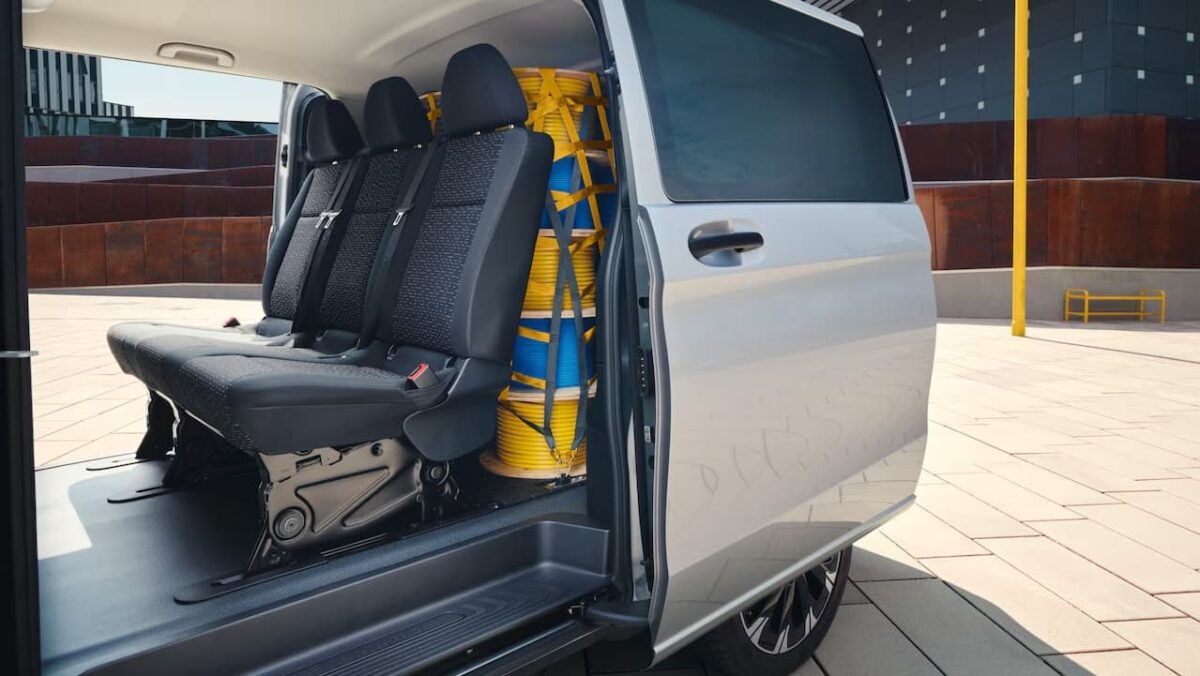
The Vito Crew Van version pairs two rows of three seats with a load area behind. It’s available in two body lengths, two diesel engine outputs and two trim levels.
Our test vehicle was the 119 CDI in top-tier Select trim and L2 body length, priced at £45,400 ex-VAT. That is a significant sum, and on the evidence of this test, the Vito increasingly trades on its badge rather than on being the most modern choice in its class.
Is this the right van for your business?
The Vito Crew suits operators who need to carry up to six people and a moderate load in the same vehicle. It is a genuine dual-purpose tool for businesses moving a team and their equipment together.
It is less suited to operators whose priority is maximum load space, since the second row of seats reduces the available cargo area compared with the panel van. It is also a difficult recommendation for operators who spend long days in the cab, for reasons covered below. Anyone evaluating purely on equipment and value, rather than on the Mercedes-Benz name, should weigh the price carefully against what the vehicle delivers.
Price and specification
The Vito Crew range is available with two diesel engines – the 163hp 116 CDI and the 190hp 119 CDI – in L2 or L3 body lengths, across Pro and Select trim levels. Both engines use a nine-speed automatic gearbox as standard.
A longer L3 body length, at 5,370mm, is offered alongside the 5,140mm L2 tested here. Standard equipment on our higher-spec Select model includes the Mercedes-Benz multimedia system, a multifunction steering wheel, wireless device charging and a smartphone integration package, with a parking package including a 360-degree camera and a digital rear-view mirror among the available options.
Sliding doors are fitted on both sides as standard, which aids crew access in tight working environments – something several rivals charge extra for.
Our 119 CDI Select L2 test vehicle was priced at £45,400 ex-VAT. That is a significant figure in this segment, and it sets a high bar for what the operator should expect in return.
Carrying capacity and payload
The L2 load compartment measures 3,678mm in length, 1,337mm in height and between 1,205mm and 1,270mm in width, with a volume of 3,600 litres. Payload for the 119 CDI L2 is 759kg against a gross vehicle weight of 3,001kg. The 116 CDI L2 carries a marginally higher payload of 773kg, owing to its lower kerb weight. Unbraked towing capacity is 750kg, rising to up to 2,500kg with a braked trailer, and the gross train weight is 5,000kg.
The load area is reduced because of the second row of seats, so it’s shorter than the panel van version of the same body. That is the inherent trade-off of a crew van. There’s no rear bulkhead, which means the load area and passenger cabin are open to each other. That’s useful for longer items, but it generates a noticeable echo in the cabin at speed.
Although you get sliding doors on both sides, this is only for passenger access. All cargo has to go in and out via the rear doors.
In the cab
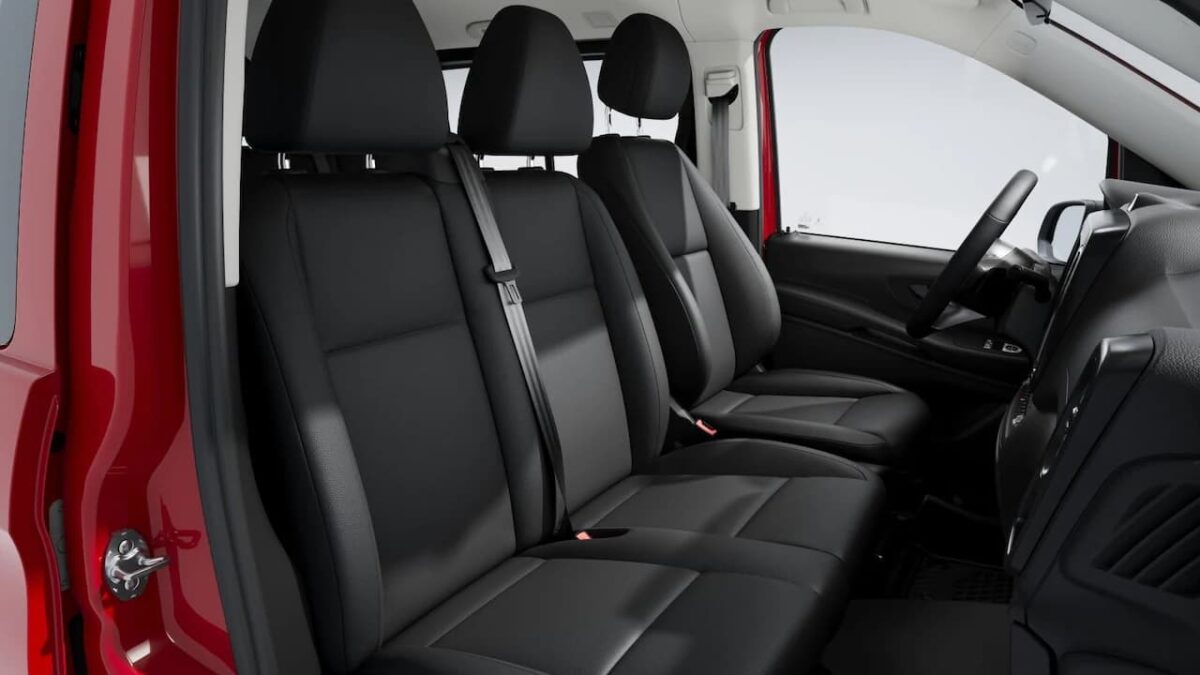
This is where the Vito Crew struggles most. The driver’s seat is uncomfortable over a working day, with a seating position closer to a bus than a modern van and a steering wheel angle that does not sit naturally. For a vehicle whose occupants may spend full days behind the wheel, this is a serious shortcoming at this price.
The steering wheel touch controls are poor – imprecise, slow to respond and requiring the driver to glance down to use reliably. Several manufacturers are moving back to physical buttons for exactly this reason, and Mercedes-Benz needs to follow. In a working vehicle, controls that demand visual attention are a safety consideration, not just an irritation.
Cabin storage is sparse. There are none of the operator-focused touches – clipboard holders, organised tool storage, task-specific pockets – that better rivals provide as standard. The cupholders are sized for cans and small bottles, not the larger flasks and bottles tradespeople often carry.
The cabin was also noisy on our test. Beyond the expected resonance from the open load area, there were squeaking trim pieces on a new, low-mileage vehicle that had not seen any hard working use. That’s disappointing for any new van, but especially so given that Mercedes-Benz charges a premium price for the Vito.
On the road
These driving impressions are based on the 119 CDI, the more powerful of the two engines. At 190hp and 440Nm of torque, it is smooth and capable for a van of this weight, and the nine-speed automatic gearbox suits the role well. The 116 CDI, with 163hp and 380Nm, will suit operators for whom outright performance matters less than running cost.
Ride quality is reasonable across the road surfaces operators will encounter. Drivers stepping up from older vans will find the diesel refinement acceptable, though anyone moving across from an electric van will notice the return to diesel character – the added noise, vibration and less immediate response.
Sport mode sharpens the steering noticeably, but the fact that the default mode needs changing to feel acceptable is itself telling. Manoeuvrability in urban environments was a concern on test – the Vito did not feel as agile as the class might lead you to expect, which matters for a vehicle that spends much of its life in town.
The parking sensors are oversensitive, triggering repeatedly in normal moving traffic. Sensors that cry wolf in everyday conditions quickly get tuned out, which undermines their value when a real hazard appears.
Running costs and ownership
The 119 CDI returns 38mpg on the official combined test, with CO2 emissions of 193g/km. The 116 CDI is marginally more efficient and worth considering where fuel cost is a priority. Both engines meet the latest Euro 6e emissions standard, so both are compliant with current clean air and ultra-low emission zone requirements – though operators should always confirm the current and projected future local rules before purchase, as these can change.
The Vito panel van was awarded a five-star Euro NCAP safety rating in 2025, with a comprehensive standard safety package. That’s a significant achievement and better than most other vans on the market; however, it doesn’t specifically apply to the Crew van as it has not been tested with the additional passenger configuration. That said, the Crew model gets all the same safety kit as the regular panel van for safe driving and accident avoidance, so the panel van’s score is pretty representative in those regards.
Verdict
The Mercedes-Benz Vito Crew Van is a capable vehicle held back by a cab that has not kept pace with newer competition. The engines are strong, the safety credentials are impressive, and the load area does the job it’s designed for. But the driver ergonomics, sparse storage and in-cab build quality do not justify the premium price in a market that has moved on.
Operators buying on the strength of the Mercedes-Benz name may still find the case acceptable. Those evaluating on current merit and value should drive it against its newer rivals before committing.
Similar vehicles
Citroën Dispatch | Fiat Scudo | Ford Transit Custom | Iveco Daily | Peugeot Expert | Renault Trafic | Toyota Proace | Vauxhall Vivaro | Volkswagen Transporter
Key specifications
Models tested: Mercedes-Benz Vito Crew Van 119 CDI Select L2
Price as tested: £45,400 + VAT
Powertrain: 2.0-litre diesel engine
Gearbox: Nine-speed automatic
Power: 190 hp
Torque: 440 Nm
Fuel consumption: 38.2 mpg
CO2 emissions: 193 g/km
Max. payload: 759 kg
Euro NCAP safety rating: Five stars (May 2025)


You must be logged in to post a comment.