




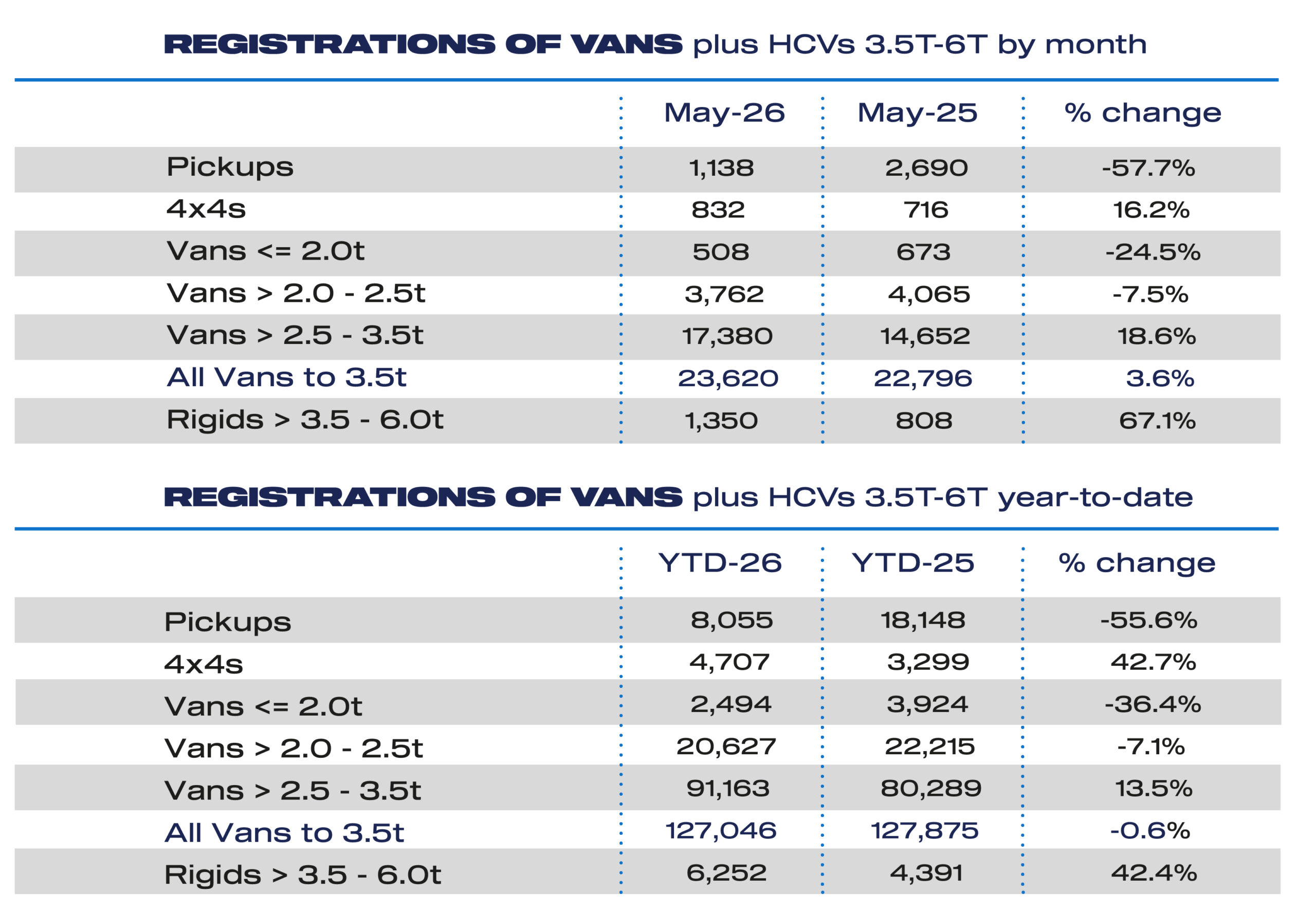
The UK new light commercial vehicle (LCV) market recorded a second consecutive month of growth in May, with registrations rising 3.6% year-on-year to 23,620 units, according to the latest figures from the Society of Motor Manufacturers and Traders (SMMT).
While overall demand remains positive, the market continues to be heavily reliant on large van registrations, while pickup sales suffered another significant decline and battery electric van uptake remains well below government targets.
Large vans drive market growth
Growth in May was largely fuelled by demand for large vans (2.5-3.5 tonnes), which increased 18.6% to 17,380 registrations. The segment now accounts for almost three-quarters (73.6%) of all new LCV registrations, up from 64.3% in May 2025.
Medium vans (2.0-2.5 tonnes) declined by 7.5% to 3,762 units, while small vans under 2.0 tonnes fell 24.5% to just 508 registrations.
The 4×4 segment performed strongly, rising 16.2% to 832 units.
However, pickup registrations continued their dramatic downturn. Sales fell by 57.7% to 1,138 units, marking the eighth consecutive month of decline. Pickups accounted for just 4.8% of the market, compared with 11.8% a year ago.
The ongoing weakness follows changes introduced in April 2025 that reclassified double-cab pickups as company cars for Benefit-in-Kind taxation purposes, significantly increasing costs for many business users.
Year-to-date market remains slightly behind 2025
Despite two consecutive months of growth, the overall market remains marginally behind last year’s pace.
Year-to-date registrations stand at 127,046 units for vans up to 3.5 tonnes, down 0.6% compared with the same period in 2025. Including pickups and 4x4s, the broader LCV market is down 0.3% at 128,274 registrations.
The biggest drag on the market continues to be the pickup sector, which has fallen 55.6% year-to-date.
Electric van registrations continue to rise
Battery electric van (BEV) registrations increased by 36% in May to 2,345 units, giving electric vans a market share of 9.8%, up from 7.6% in May last year.
While this represents healthy growth in volume terms, BEV market share fell back from April’s 11.1% and remains significantly below the government’s Zero Emission Vehicle (ZEV) Mandate target of 24% for 2026.
Year-to-date, electric vans account for 9.5% of all new registrations, only slightly ahead of last year’s 8.2% and still below the original 2024 target of 10%.
Diesel remains dominant, representing 83.9% of May registrations and 83.4% of the market year-to-date.
Good month, bad month
While the overall market grew by 3.6% in May, it wasn’t the same story for everyone. Some brands will be celebrating a stronger performance than others.
Those brands of note are Renault, Volkswagen and Maxus – which saw registrations grow by 62%, 46% and 464% respectively. Other above-average performers include Mercedes-Benz, Land Rover, Nissan, Renault Trucks, Isuzu Truck, Ineos, Fuso and Dacia. These brands outperformed the overall LCV market by at least 10%.
Meanwhile, things were not as positive for Isuzu, Toyota, Iveco, Vauxhall, Ford, KGM and Citroën. All of these brands underachieved against the overall market by at least 10%.
The following brands were about where you’d expect them to be: Peugeot, Fiat and MAN. All of these brands had results that were within +/- 10% of the overall market.
Ford Transit Custom stays on top
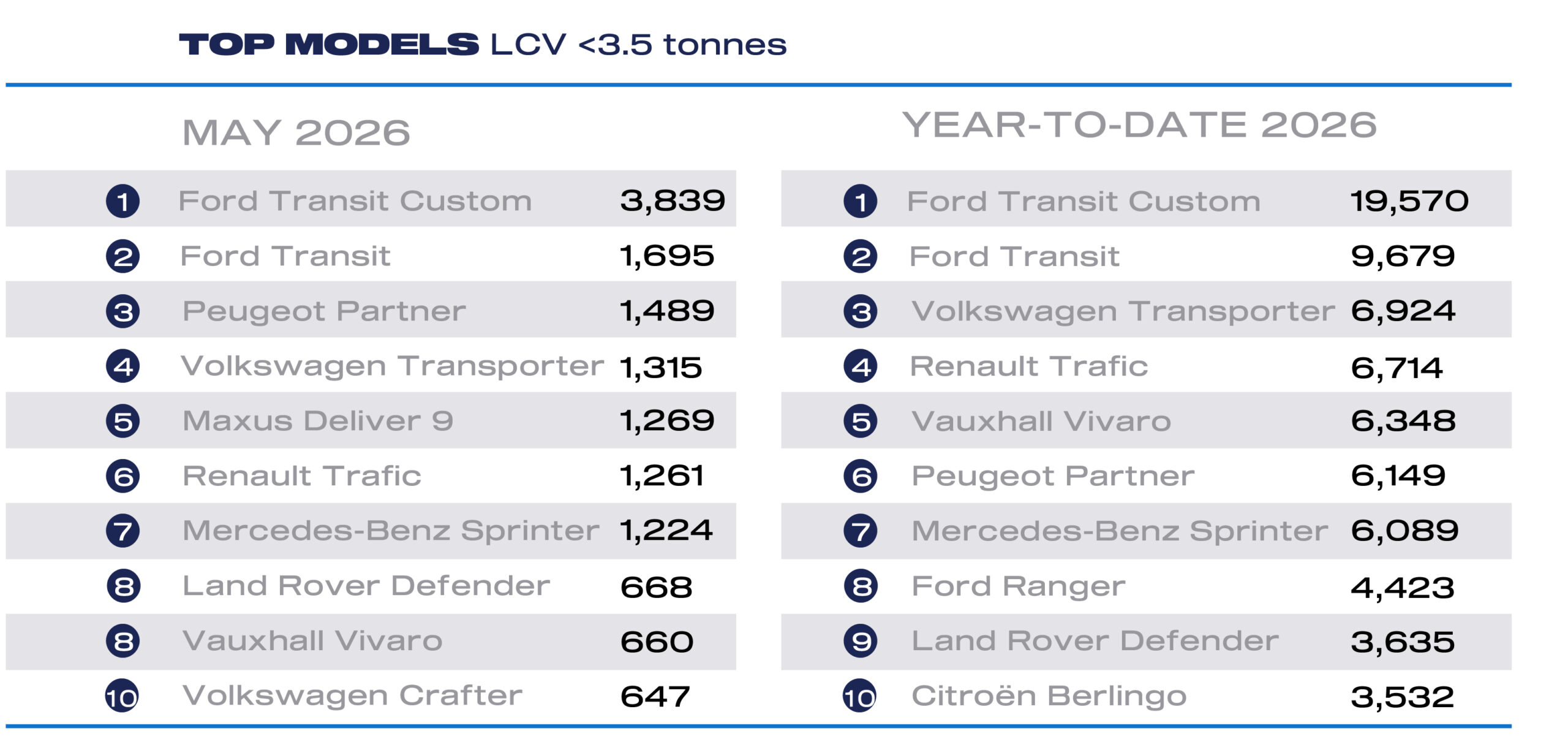
The Ford Transit Custom maintained its position as Britain’s best-selling van in May with nearly 4,000 registrations – more than double the sales of any other model.
Ford also occupied second place with the Transit, while the Peugeot Partner secured third.


You must be logged in to post a comment.